Benefits of White-Labeling Your Education Platform
In a crowded education market, perception matters as much as pedagogy. Parents evaluate your professionalism before their child attends a single class. Students form impressions based on the tools they interact with daily. And franchise partners need brand consistency that reinforces the network's reputation at every touchpoint.
White-labeling your education platform, making a fully developed technology system look, feel, and function as if it were built by your organization, is one of the most effective ways to strengthen your brand while keeping costs under control. Here is a deep look at why this approach is transforming education businesses worldwide.
What White-Labeling Actually Means in Education
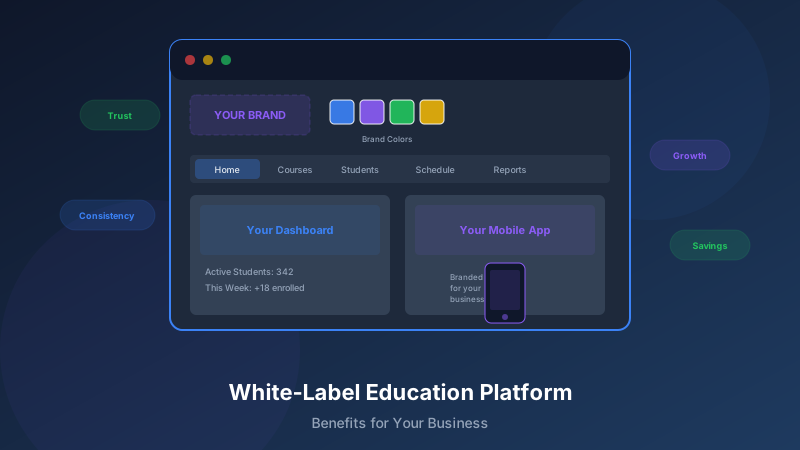
White-labeling in the education context means adopting a learning management system, student portal, parent app, or administrative platform developed by a technology provider, and rebranding it entirely as your own. Students log in to your domain. Parents download your app from the App Store. Teachers see your logo every time they open the dashboard. The underlying technology is maintained by the provider, but the experience belongs to your brand.
This is distinct from simply using a third-party tool. When you use a generic platform, your students see that platform's branding, their domain, and their design language. White-labeling removes that layer entirely.
Brand Consistency Across Every Touchpoint
Why Consistency Matters in Education
Parents making enrollment decisions are looking for signals of professionalism, reliability, and organization. A fragmented technology experience, where the website looks one way, the student portal looks another, and the mobile app carries a third-party name, creates subtle but real doubts.
Research in consumer psychology consistently shows that brand consistency across channels increases trust and perceived quality. In education, where parents are entrusting their children's development to your organization, this trust is foundational.
How White-Labeling Delivers Consistency
A white-labeled platform ensures that every digital touchpoint reinforces your brand:
This consistency creates a seamless experience where families never question whose platform they are using. It is always, unmistakably, yours.
Professional Image Without the Professional Price Tag
The Perception Gap
Small and mid-sized education businesses often compete against national brands with massive technology budgets. Without a polished digital presence, they risk being perceived as less capable, even when their teaching quality is superior.
A white-labeled platform closes this gap immediately. A single-location tutoring center can present the same caliber of digital experience as a nationwide chain, complete with branded mobile apps, professional dashboards, and polished parent communications.
What Families See
When a parent evaluates your program, they notice:
These perceptions are not superficial. They directly influence enrollment decisions and willingness to pay premium pricing.
Branded Mobile Apps: The Competitive Edge
Why Mobile Matters
Mobile is the primary way parents interact with education services outside of drop-off and pick-up. They check schedules on the bus. They review progress reports during lunch breaks. They message teachers from the couch after bedtime.
A branded mobile app, one that parents download from the App Store with your name and your icon, transforms you from a service provider into a daily presence in their lives.
The Economics of Branded Apps
Building native mobile apps (iOS and Android) from scratch costs $100,000 to $300,000 for initial development, plus $50,000 or more annually for maintenance, updates, and app store compliance. For most education businesses, this investment is prohibitive.
White-label providers like Calimatic offer branded mobile apps as part of their platform, giving you App Store and Google Play presence at a fraction of the cost. Your app, your name, your brand, none of the engineering overhead.
What a Branded App Communicates
Custom Domains and Branded Portals
The Power of Your Own Domain
When students log in at learn.youracademy.com instead of genericplatform.com/youracademy, the difference in perception is immediate. A custom domain communicates ownership and permanence.
Custom domain benefits include:
Portal Customization
Beyond the domain, white-label platforms allow you to customize the portal experience itself:
Franchise Brand Compliance
The Franchise Challenge
Franchise education networks face a unique brand management challenge. Every location must maintain brand standards while operating semi-independently. Without centralized technology, brand consistency erodes quickly:
How White-Labeling Solves It
A white-labeled platform provides the franchisor with centralized brand control:
For franchise networks, white-labeling is not just a branding advantage; it is an operational necessity. Read more about how to streamline education franchise operations with centralized technology.
Building Trust with Students and Parents
Trust as a Growth Engine
In education, trust drives everything: enrollment, retention, referrals, and willingness to pay premium pricing. Trust is built through consistent, reliable experiences over time.
A white-labeled platform contributes to trust in several ways:
Reliability
Transparency
Professionalism
The Referral Effect
Parents who trust your brand become advocates. When they recommend your program to other families, a branded app and professional portal make that recommendation more credible. The referred family can download your app, explore your platform, and experience your professionalism before they ever walk through your door.
Reduced Development Costs and Risk
What You Are Not Spending
By choosing a white-label approach, you avoid:
Where That Budget Goes Instead
The money you save on technology development can be redirected to areas that directly impact student outcomes and business growth:
The education businesses that thrive are the ones that invest in education, not the ones that invest in software engineering. For a detailed cost and feature comparison, see our analysis of white-label LMS vs. building your own.
Faster Time to Market
Speed as Strategy
In education, timing matters. The back-to-school season, summer enrollment periods, and January fresh-start campaigns all create windows of opportunity. If you are waiting 12 to 18 months for a custom platform to be built, you are missing enrollment cycles that will not come back.
White-label platforms can be configured, branded, and launched in two to six weeks. That means:
Iterative Improvement
Launching quickly does not mean launching with a poor experience. White-label platforms are mature products with years of refinement. Your first day on a white-labeled platform is better than most custom builds after a year of development, because you are inheriting the accumulated improvements driven by thousands of education businesses.
Scalability Without Rearchitecting
Growing Pains, Solved
One of the most expensive aspects of custom-built platforms is scaling. A system built for 100 students often needs significant rearchitecting to serve 1,000. A system built for one location may not support ten without major infrastructure changes.
White-label platforms are built for multi-tenant, multi-location scale from the ground up. When you grow, the platform grows with you:
Predictable Costs at Scale
With a subscription model, your technology costs scale predictably with your business. There are no surprise infrastructure bills, no emergency developer hires, and no scaling-related outages. You can forecast your technology spend with confidence.
Competitive Differentiation
Standing Out in a Crowded Market
The education market is increasingly competitive. Parents have more options than ever, and they are comparing providers across multiple dimensions: curriculum, convenience, cost, and digital experience.
A white-labeled platform gives you competitive advantages that are visible from day one:
Differentiation Without Distraction
The key insight is that white-labeling lets you differentiate on brand and experience without diverting resources from what truly makes you different: your teaching methodology, your curriculum, your people, and your culture. The technology reinforces your differentiation rather than consuming the resources you need to create it.
Conclusion
White-labeling your education platform is not about taking shortcuts. It is about making a strategic decision to invest your resources where they matter most. You get enterprise-grade technology, branded to your identity, delivered to your students and families through your app, your portal, and your domain, at a cost that makes sense for an education business.
In a market where brand perception directly influences enrollment, retention, and referrals, the ability to present a polished, consistent, and professional digital experience is not optional. It is essential. White-labeling makes it accessible to education businesses of every size, from a single tutoring center to a nationwide franchise network. To learn how branding extends beyond technology, explore our guide on building a branded education business that stands out.
Your brand is your promise to families. Make sure your technology keeps that promise.