Franchise Royalty Tracking and Reporting: A Guide for Education Brands
For education franchise brands, royalty revenue is the financial engine that funds corporate operations, curriculum development, marketing campaigns, and franchisee support. Getting royalty tracking right is not just an accounting exercise. It directly affects your ability to grow the network, support your franchisees, and make sound strategic decisions.
Yet many education franchise systems still rely on manual processes, disconnected spreadsheets, and monthly self-reporting from franchisees. This creates delays, inaccuracies, disputes, and a lack of real-time visibility into the financial health of the network. Effectively streamlining franchise operations starts with getting royalty tracking right.
This guide covers everything education franchise brands need to know about royalty tracking and reporting: how royalties work, common models, the problems with manual tracking, and how automated systems transform the process.
Understanding Franchise Royalties in Education
What Are Franchise Royalties?
Franchise royalties are ongoing fees that franchisees pay to the franchisor for the right to operate under the franchise brand and use its systems, curriculum, and support. They are distinct from the initial franchise fee, which is a one-time payment at the start of the relationship.
Royalties fund the franchisor's ongoing obligations, including:
Curriculum development and updates: Keeping instructional content current and effectiveTechnology platform maintenance: Running the systems franchisees use dailyTraining and support: Ongoing coaching, webinars, and in-person training eventsBrand marketing: National and regional advertising campaignsQuality assurance: Ensuring consistent standards across all locationsCorporate operations: The franchisor's own staffing, legal, and administrative costsCommon Royalty Models
Education franchises typically use one of these royalty structures:
Percentage of Gross Revenue
The most common model. Franchisees pay a set percentage of their total revenue each month.
Typical range: 7-10% of gross revenuePros: Scales with the franchisee's success; the franchisor earns more as franchisees growCons: Requires accurate, timely revenue reporting from each location; can feel burdensome for lower-revenue locationsFlat Monthly Fee
Franchisees pay a fixed amount each month regardless of revenue.
Typical range: $1,000 - $5,000/month depending on the brand and marketPros: Simple to calculate and predict; no disputes about revenue figuresCons: Does not scale with success; can be disproportionately heavy for new or struggling locationsTiered or Sliding Scale
The royalty percentage changes based on revenue thresholds.
Example: 8% on the first $50,000/month, 6% on revenue above $50,000Pros: Rewards high-performing franchisees; balances franchisor revenue with franchisee growthCons: More complex to calculate and track; requires precise revenue breakdownsPer-Student Fee
Franchisees pay a fixed fee for each enrolled student.
Typical range: $5 - $25 per student per monthPros: Directly ties franchisor revenue to network size; easy for franchisees to understandCons: Requires accurate enrollment tracking; does not account for differences in program pricingHybrid Models
Some franchisors combine models, such as a minimum flat fee plus a percentage of revenue above a certain threshold. These models ensure baseline franchisor revenue while still scaling with franchisee growth.
Marketing Fund Contributions
In addition to royalties, most franchise agreements require a separate contribution to a national or regional marketing fund.
Typical range: 1-3% of gross revenuePurpose: Funds brand-level advertising, digital marketing campaigns, and marketing materialsTransparency: Franchisees often expect (and should receive) regular reporting on how marketing funds are spentThe Problem with Manual Royalty Tracking
Many education franchise systems, especially those with fewer than 50 locations, still track royalties using manual or semi-manual processes. Here is why that is a problem.
How Manual Tracking Typically Works
Each franchisee calculates their own revenue for the monthThey submit a self-reported revenue statement to corporate (often via email or a shared spreadsheet)Corporate staff manually calculates the royalty amount based on the reported figuresAn invoice is generated and sent to the franchiseeThe franchisee makes a payment (often by check or manual bank transfer)Corporate staff reconciles the payment against the invoiceDiscrepancies are identified and resolved through back-and-forth communicationWhy This Breaks Down
Accuracy Issues
Franchisees may unintentionally (or intentionally) underreport revenueManual calculations introduce human errorDifferent locations may use different accounting methods or reporting periodsRevenue from multiple programs, one-time fees, and materials sales may be inconsistently reportedTimeliness
Self-reporting often comes in lateCorporate staff spend days chasing down missing reportsRoyalty calculations may not be complete until weeks after the reporting period endsLate payments create cash flow problems for the franchisorDisputes and Trust
When revenue figures come from self-reporting, disputes are inevitableFranchisees may question how royalties are calculatedThe franchisor may suspect underreporting but lack the data to prove itThese disputes erode the trust that is essential to a healthy franchise relationshipScalability
What works for 10 locations becomes unmanageable at 30Every new location adds another manual reporting relationshipCorporate staff spend more time on royalty administration and less on supporting franchiseesThe cost of managing the process grows linearly with the networkLack of Real-Time Visibility
The franchisor cannot see how the network is performing until reports come inUnderperforming locations are not identified until it is too late to interveneFinancial planning and forecasting rely on outdated dataBoard reports and investor updates are always based on stale numbersAutomated Royalty Tracking: How It Works
Automated royalty tracking eliminates the manual steps by connecting directly to the source of truth: the operational data at each franchise location.
The Automated Process
Revenue is captured automatically as tuition payments, fees, and other transactions are processed through the franchise management platformRoyalties are calculated in real time based on the rules defined in each franchise agreementDashboards update continuously so the franchisor can see revenue and royalty figures at any timeInvoices are generated automatically at the end of each reporting periodPayments are collected electronically via ACH, credit card, or automatic bank debitReconciliation happens automatically as payments are matched to invoicesExceptions and discrepancies are flagged for review without requiring manual comparisonKey Capabilities of Automated Systems
Configurable Royalty Rules
Support for percentage, flat fee, tiered, per-student, and hybrid modelsDifferent rules for different franchise agreements or location tiersAutomatic adjustment for new locations during ramp-up periodsHandling of royalty holidays, caps, or promotional ratesPer-Location Financial Visibility
One of the most valuable aspects of automated tracking is per-location profit and loss (P&L) visibility.
For each location, the franchisor can see:
Gross revenue: Total tuition and fee incomeRevenue by program: Breaking down income by tutoring, test prep, STEM, etc.Enrollment metrics: Active students, new enrollments, churnRoyalty amount: Calculated in real timePayment status: Paid, pending, overdueTrends: Month-over-month and year-over-year comparisonsThis level of detail allows the franchisor to identify which locations need support, which are outperforming, and where to focus growth efforts.
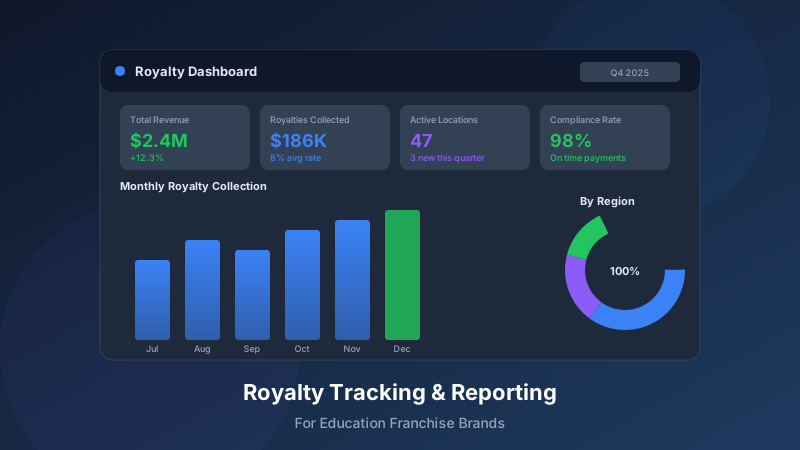
Network-Wide Dashboards
Beyond individual locations, automated systems provide aggregate views:
Total network revenue and royalty incomeAverage revenue per locationNetwork growth trends (enrollment, revenue, locations)Royalty collection rates and outstanding balancesGeographic and regional performance comparisonsCompliance and Audit Trails
Automated systems create a complete audit trail for every transaction:
Every revenue event is logged with a timestamp and sourceRoyalty calculations are documented with the rules that were appliedPayment records are linked to specific invoices and reporting periodsChanges to royalty rules or franchise agreements are trackedThis audit trail is invaluable during franchise audits, tax preparation, and any dispute resolution.
Setting Up Effective Royalty Reporting
Define Clear Royalty Policies
Before implementing any tracking system, ensure your royalty policies are crystal clear:
What counts as gross revenue? Does it include materials sales, registration fees, late payment fees, or only tuition?When are royalties calculated? On a cash basis (when payment is received) or accrual basis (when revenue is earned)?What is the reporting period? Monthly is standard, but some brands use weekly or bi-weeklyWhen are royalties due? Typically 10-15 days after the end of the reporting periodWhat happens with late payments? Define penalties, interest, or escalation proceduresHow are disputes resolved? Establish a clear process before disagreements ariseImplement Standardized Financial Reporting
Require all franchisees to use the same:
Chart of accounts: Standardized categories for revenue and expensesReporting format: Consistent templates for P&L statements and revenue reportsAccounting period: Same calendar month for all locationsManagement platform: All locations on the same system ensures data consistencyBuild Useful Dashboards
Effective royalty dashboards should answer these questions at a glance:
How much total royalty revenue was collected this month?How does that compare to projections and prior periods?Which locations have not submitted reports or payments?Which locations are underperforming relative to their potential?What is the overall collection rate?Are there any trending issues across the network?Schedule Regular Financial Reviews
Weekly: Quick check on collection status and outstanding balancesMonthly: Detailed review of per-location performance and royalty calculationsQuarterly: Network-wide financial review with trend analysis and forecastingAnnually: Comprehensive audit and franchise agreement compliance reviewChallenges and Solutions
Challenge: Franchisees Resist Transparency
Some franchisees may push back against systems that give the franchisor direct visibility into their financial data.
Solution: Frame transparency as mutually beneficial. When the franchisor can see performance data in real time, they can provide better support, identify issues earlier, and help underperforming locations improve. Make it clear that transparency protects the franchisee as well by eliminating disputes and ensuring accurate calculations.
Challenge: Multiple Revenue Streams
Education franchises often have complex revenue models: tuition, registration fees, materials, camps, workshops, assessments, and more.
Solution: Use a platform that captures and categorizes all revenue streams automatically. Define clearly in the franchise agreement which revenue streams are subject to royalties and configure the system accordingly.
Challenge: New Location Ramp-Up
New franchise locations typically have reduced or waived royalties during their initial operating period.
Solution: Configure location-specific royalty rules in the system. Set start dates, ramp-up schedules, and automatic transitions to full royalty rates so nothing falls through the cracks.
Challenge: Multi-Unit Operators
Franchisees who own multiple locations may want consolidated reporting, while the franchisor needs per-location detail.
Solution: Use a system that supports both views. Multi-unit operators should see a consolidated dashboard for their portfolio, while the franchisor sees each location individually and in aggregate.
The Impact of Getting Royalty Tracking Right
When education franchise brands move from manual to automated royalty tracking, the results are significant:
Revenue accuracy improves: Self-reporting discrepancies are eliminatedCash flow becomes predictable: Automated collection reduces late paymentsAdministrative costs drop: Staff spend hours, not days, on royalty managementFranchisee trust increases: Transparent, automated calculations reduce disputesDecision-making improves: Real-time data enables proactive managementScalability unlocks: Adding new locations does not add proportional administrative burden, as demonstrated in real-world franchise growth storiesA purpose-built franchise management platform like Calimatic handles the entire royalty lifecycle, from revenue capture at the point of sale through calculation, invoicing, collection, and reporting. Integrated billing and payments capabilities ensure every transaction is captured accurately. For education brands that are growing their franchise network, this kind of automation is not a luxury but an operational necessity.
Building Your Royalty Tracking Roadmap
If you are currently using manual processes, here is a practical path to automation:
Phase 1: Standardize (Month 1-2)
Document your royalty policies and calculation methodsStandardize the chart of accounts across all locationsAudit current reporting for consistency and accuracyIdentify the most common errors and disputesPhase 2: Centralize (Month 2-4)
Move all locations onto a single management platformConfigure royalty rules for each franchise agreementSet up automated revenue capture and categorizationBuild initial dashboards and reportsPhase 3: Automate (Month 4-6)
Enable automated royalty calculation and invoicingSet up electronic payment collectionImplement automatic reconciliation and exception flaggingTrain corporate staff on the new reporting toolsPhase 4: Optimize (Ongoing)
Refine dashboards based on what leadership actually usesAdd predictive analytics for revenue forecastingImplement benchmarking tools to compare location performanceUse data to inform franchise development and support strategiesFinal Thoughts
Royalty tracking may not be the most exciting aspect of running an education franchise, but it is one of the most important. Whether you are evaluating the franchise vs. independent learning center model or already operating a multi-unit network, accurate, timely, and transparent royalty management strengthens the financial foundation of the entire franchise system. It builds trust between franchisor and franchisee. It provides the data needed to make smart decisions. And it scales gracefully as the network grows.
The education franchise brands that invest in automated royalty tracking and reporting are the ones that can focus their energy on what matters most: helping franchisees succeed, improving curriculum and instruction, and ultimately delivering better outcomes for the students and families they serve. For a broader look at leveraging analytics across your network, read our guide on data-driven decision making in education.
If your franchise is still tracking royalties manually, now is the time to make the shift. The investment pays for itself quickly in saved time, improved accuracy, and better decision-making across the network.